The bee is grounded on the hot asphalt in the grocery store parking lot. She’s taking a few slow steps but she won’t fly and it will take her far too long to find safety.
I crouch and pick her up. She wanders the unfamiliar landscape of my hand but she seems to like the warmth.
The flower planter is across the driveway and I take her over and slide her off onto a flower but she turns quickly and climbs back into my hand. She refuses to leave so I take her back and look closer; that’s when I see the injury, a long slash across her thorax. She sits still on my hand and I realize she hasn’t moved her wings the entire time.
I think she is dying.
I ask her again to sit among the flowers but she clings now to my fingers and I give up. I go back to the car, buckle one-handed, drive home one-handed. She rests in my open palm, soaking in the warmth from my skin.
There are no flowers at home, this late in the season, so I go to my aunt’s house to the flower garden there. I sit in the long grass next to the rows of flowers and I listen to the other bees working and I just hold my bee.
It is almost an hour before her movements become uncoordinated and confused. She lurches around on my hand and then slowly she stops moving.
I wait, forgetting to breathe, watching her. How do you know when a bee is dead? I don’t know. So I wait a little more, then I carefully slide her off my hand into the flower bed. I leave her there, hidden under the blossoms, and I stand up.
This is the first lesson.
Three years later I come home from class. We have learned how to try to stop someone from dying, how to negotiate with death, how to bargain for a little more life. It is late when I get home.
I walk into the kitchen and my rabbit B is standing up, leaning out the open door of her house, waiting for me. Her ears are tinged blue and her mouth is open as she gasps for air and I know, all at once, that she is dying. And I know that unlike most rabbits she is waiting for me.
I sit down on the floor and B flings herself out of her house into my lap. I lift her into my arms and all she wants to do is lean into my warm body. I have known her since the hour she was born and she has never asked to be held except for this moment, now, at the end of her life, but for such a silent creature her request echoes through the house.
I remember the bee.
I hold her, adjusting her position so she can breathe a little easier. She pushes her head under my hand, burrowing in for safety, and I let her.
I hold her. What else can I do? What can anyone do? I want to ease her suffering but she is already very close to the end. So I hold her, for a few minutes more, until I let her go.
This is the second lesson.
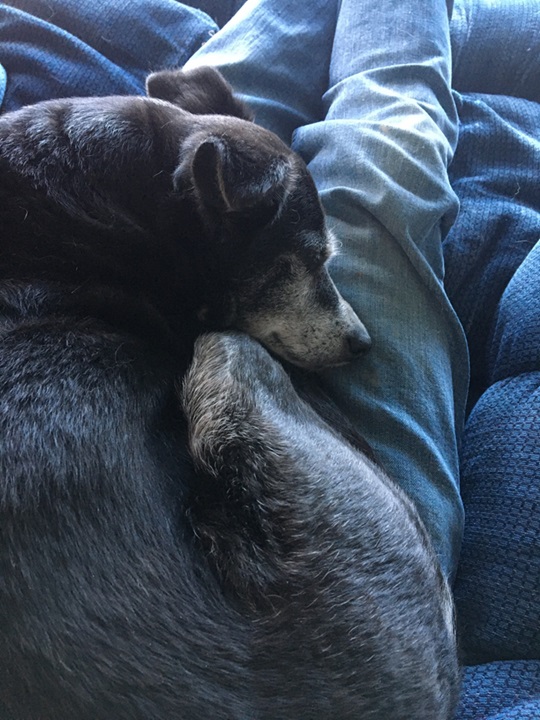
I have never seen an animal so distraught. My dog lunges at the dead rabbit in my arms, pushing at her head and mouth, whining and crying. She knows something is wrong: she wants B to breathe.
I hold her now, too, a dead rabbit in one arm and a frantic dog in the other. After a while I rest B in a box for the night and I take my pup upstairs, shut her in my room to sleep. For days she is listless and depressed, constantly sniffing B’s house, checking to see if she’s come back. I bribe her to eat with a bagel and cream cheese from the Cafe. I coax her out on walks. I ask her what she needs and when she does not know I do my best to figure it out.
This is the third lesson. I think this is the hardest.
Lesson One: Be there. Be open. Be willing to walk this road even if it might hurt.
Lesson Two: Know when to let her go. Know when to step back. Know when to say goodbye.
Lesson Three: The ones left behind need more care then the ones who died. Let the dead rest and let the others grieve.
Me: Kimberly and I read a short segment on the benefit of moving from hope (about results) to hopelessness. I understood it to be similar to my moving from evaluating my journey based on success of whatever kind as taught by dad to understanding that my own soul is your whole focus. When I settle into that view, success becomes incidental and things falling apart around me… do not undermine my ability to live into the good because I AM the good regardless of my context. So like the reading, I “lose hope” in results or I give up on trying to bring them about (or focus on just surviving in disaster). I’m called to move more deeply into love regardless of the context. I’m trying to learn to just let my hard feelings be. I mean I need to listen to them as they tell me of needs I have, but often I don’t know what I need. I think unhappy feelings are usually (always?) alerting us to something we need, but I am coming to think that they are doing something of value even if I can’t understand them… for instance, helping us be better listeners to our spirits or slowing us down or helping us be empathetic.
God: I’m sad that you were so deeply scarred in your view of me as some harsh, hard-nosed master. I’m sad not just because it hurt you, but because it so deeply hurt our relationship. I hate that that happened. But as you know all things can be redeemed, so the end will be better than if you had not had that terrible struggle. The kitchen garbage makes the soil rich for growing beauty of all kinds. All your pain I will compost into beauty over time. I hope you can trust me with that. Even our relationship is going to blossom far more and go much deeper than it would have without your long suffering. Thank you for letting me in to transform that for you because nothing fills me more than sinking deeper into relating with you. You are my joy!
Me: Thank you. That is very encouraging. Help me rest more often in that view that you are constantly doing good in me, dwelling more intimately within me. How amazing!
Me: …Anxiety is not a failure. It is just informing me of what needs attention and care…. I think anxiety is inviting me to notice my inner trouble and encouraging me to then lean into grace which has somehow gotten away from me, and to trust your grace to come through for me whether my anxiety is lessened or not. Oh “come through for me” can be confused with fixing. Really the form of grace I need most is compassion, to believe you care deeply for my pain. Like a little kid who would run to his supportive mom, not mostly to fix the problem, but to receive that understanding, validation, and comfort. I used to think quite [strongly] that you were primarily into my character building, making me a better person. That looks similar enough to be confused with grace, but it is the opposite. Now I believe you only wish for me to grow into all the beauty that is seeded in my soul. I thought I was the gardener and now see I am the garden!
God: What a wonderful way of seeing my love and delight in your unique beauty! And it is truly the responsibility of the gardener to foster the natural beauty of the garden. I love that you trust me for that. I know that is a struggle and has been your whole life, but look how much you have grown! You have overcome major challenges to trust, and really it is all about the direction, not the speed or attainment. In fact, looking at it as attainment pulls you away from my grace and turns our relationship into legalism. The key to close connection is in walking the journey together, not achieving some goal. I love that you are walking the journey with me. How delightful!
Me: So we read together [Kimberly and I]. Rohr said that the only way we can connect with what is outside of us is if there is some correspondence inside us. So God planted all his goodness in us in unique ways. We are not originally evil. Evil is an accretion. I always thought good was something to acquire and impose on my bad self, but this idea invites us to embrace all the goodness within us and foster its growth. It is not about bringing the good in from outside, but finding resonance within us to that good. So what do you think about that?
God: Yes, creation, all of creation, reflects me. How could it not if it sprang from me? I made you. I made you good. I made you to show my goodness in your own unique way. That goodness in you can never be killed, but is eternally beyond your ability to destroy. It is the diamond that might be covered in mud or rock or ocean, but is still a beauty beyond expression. Were I to write down all the unique good that is in you, it would be larger than the encyclopedia… it would take a lifetime to read. Eternity will be spent discovering and growing all the beauty within you. I want you to see your own beauty as much as you see the beauty of nature, of dogs, of all that you take joy in. I want you to see your beauty as much as I see your beauty.
Me: I wish I could too! The barnacles that block my good from expressing itself also block my view of my good. I see the barnacles and think they are a reflection of the true me. I also see all that I am designed to express and realize how far I have to go, how immature I am.
God: But I hope you understand that your growth in beauty is something that will unfold through all of eternity. There is this false sense that “mature” is some stage that everyone should aim for and eventually “arrive” and that immature is somehow inadequate or something to get passed. Imagine a sapling being upset that it is not a tree. Growth is just a continual process that never ends, and varies dramatically for many reasons (note the rings on a tree!), and the growth of one cannot be compared to the growth of another. A sapling in the desert will take a very long time to grow. Softwood grows fast, but hardwood is stronger, and cactus is resilient, and … everyone is unique and beautiful in their own way. When you use future beauty to shame present beauty, the whole concept of unfolding beauty is turned on its head.
Life drains away my peace and I lose hold of what I most deeply need. So I’m reminding myself and you:
God is so gentle. He does not force or manipulate or rush us. He does not ignore or dismiss or abandon us. He is always present, wooing us and inviting us and waiting patiently for us. He knows our pain and woundedness. He sorrows with our grief and fear. He speaks kindly to our hearts and never gives up. He never gives up no matter how misguided or confused we are, no matter how stubborn or withdrawn we are. He treats us like a kindhearted foster treats a dog cowering in the corner of the kennel. He knows our struggle to trust him does not come from ill will, but from the many times we have been hurt and frightened in this unsafe world. And we keep getting hurt, over and over. We are judged and rejected, misunderstood and mistreated in so many small and big ways. Our plans fail. Our heart gives out. Our hope dims. But God is always offering us his gentleness and acceptance, his empathy and love.
Kate DiCamillo tells a beautiful story that resonates so much with the little boy inside of me:
I was standing in the grocery store checkout line, and a small boy walked past me—once, twice, three times. When he came back the fourth time, he was holding his mother’s hand. “That’s her,” he said. He pointed at me. “Don’t point, honey,” said his mother. And then to me she said, “My son’s class is reading The Tale of Despereaux. He thinks that you’re the author of that book.” “I’m the writer!” I said. “Oh,” she said. “How lovely. Is it okay if he asks you a question?” “Absolutely,” I said. “Go ahead, honey,” she said to the boy. This child looked up at me and said, “What I want to know is will it be okay? Will the mouse be okay?” “Yes,” I told him. “Oh,” he said. “Good. Now I can relax my heart.” “Yes,” I said again. “You can.” Oh, his heart! Oh, my heart! Oh, all our hearts!
When the world around me feels like it is fracturing apart, when I feel lost and confused in my own journey, when terrible news strikes home or the fear of terrible news, I need the author of my story to put a hand on my shoulder and say, “You will reach home at last.” As Julian of Norwich wrote, “All will be well and all will be well, and all manner of things will be well.” That is not to say that nothing will go wrong, perhaps terribly wrong, but I will reach the other side of all that is tragic and miserable and frightening. On the other side is an inescapable, unstoppable hope.
Kimberly and I are quite resistant to shallow and easy optimism or “toxic positivity” which minimizes struggles and shouts down suffering, but we recently stumbled on a delightful idea called “ominous positivity,” and I have had a lot of fun writing up memes for that genre. “If I have to tell you one more time, you’re going to get an earful of how wonderful you are!” or “You can’t get away! I’m going to chase you down and dump blessings all over you!” or “You are forever condemned to a life of being extravagantly loved!” The idea is that we can do nothing to escape the good God is directing our way like a Niagara of love. It may not lessen our suffering, but it promises to redeem suffering into something awesome.
What I want to know is will it be okay? Yes! Oh, good! Now I can relax my heart! Yes, yes you can!
ME: More mornings than before are like this morning, I seem to wake to an unhappiness and talking to you while lying in bed does not seem to get me to a better space, so here I am again, completely unmotivated and unable to enjoy the morning, which is unfortunate. I find myself touched by some FB posts or pictures, but I don’t really know what to do with that. Perhaps coming here to sit with you about it would help. I so need to connect to my true self and the good of life. There is so much good to lean into even in the worst of times. Wendell Berry and Mary Oliver invite me into nature in this way. Nature is a lifeline to good because it has prevailed through all and will continue to do so because life is irrepressible regardless of the evil humanity does to itself and the world. It is a bigger story like You and eternity (but more easily accessible sometimes). Connecting to what is true in others through poetry, music, and art can help also. Too often the good feels like little pockets or bubbles that are immersed in the greater reality of the bad. After all, if good were greater, we would make constant progress as humanity when instead we seem to simply repeat cycles of self-destructiveness with recovery, and I’m not even sure the recovery comes from goodness. It may just be a counter force that is merely a lesser evil. The world is ruled by force so that our goodness does not shape the context, but is within the darker context. It influences the context, naturally, and keeps it from becoming even darker, but power always controls, and perhaps that is what Jesus came to teach us—that goodness shines clearer in the contrasting darkness and is strengthened within us by that challenge. “The kingdom of God is within.” Perhaps I am measuring the wrong thing, the context or container instead of the life within, just as the earth is a speck in the dark, lifeless universe and yet the earth is the center of what matters. But when I start to think of my response as the key instead of the dark situation, I see how defective my responses are. Do I have more light in me than darkness—darkness of fear, ignorance, reactivity, self-loathing? I am healing, but the journey is long and I have trouble seeing that the importance lies in the direction rather than the attainment. I should also take note that the context heavily impacts the inner life. It is always “uphill both ways.” The surrounding darkness is full of traps, obstacles, vortexes, deceptions and the like. The good in me is tangled and complex. But then I remember that grace is key not only as the target but also as the means. Grace above all, especially towards myself. I stumble often, but this does not define me. Grace defines me. If I succeed in giving myself grace, true, deep grace, I am living from the good into the good.
GOD: I’m so glad you finally landed back in grace! That is the whole of good. There is no true virtue except it springs from grace and grace heals all. Darkness that ends in grace is transformed, the wrong into good, and virtue that is outside of grace is a deceptive undoing of the good. Grace is all. This is my heart and to live in grace is to live in me. Of course it is a powerful and rich grace, not the cheap imitation that minimizes the impact of the darkness–but no darkness is beyond redemption, which turns it into a source of light. That is the real purpose of shame as it awakens you to the harm and invites you into the only remedy, which is grace, not greater effort. I love how you keep growing in this and coming back to it. The fact that you make your way back here clearly shows that it is at heart what you ground your life in, however distracted you may become at times. This dance between you and me is wonderful, joining our hearts in the one bond that holds against all, which is grace. I welcome you back here! So glad to see you here again! You are a joy to me!
6) I thought some feelings like anger and fear were wrong and God judged me for them. I believed I must override those emotions, talk myself out of them, and stop feeling them. I discovered that all feelings were created by God and were good, as vital to listen to and pay attention to as the gauges on the dashboard of my car. I don’t “like” that my gas gauge is near empty, but I’m really grateful that it is telling me so. They are the royal road to self-understanding and relational bonding.
7) I thought some feelings like love, joy, and peace were commanded by God and a sign of spirituality. After all, these were the first three “fruits of the Spirit,” not considering that fruit is an organic result not an intentional effort. I worked hard at pumping up these feelings with self-talk, worship songs, inspiring readings, and prayer. I discovered that God does not command feelings, he animates feelings by loving us inordinately. Our feelings are just responses to the good he pours into us. I am invited to just sit under that sun and soak it in, bury myself in that embrace, fill my heart with that sweetness. My goal now is not loving God, but receiving God’s love for me. Then loving God is as natural and spontaneous as laughing at a good joke or saying “mmmm!” over a good dessert.
8) I was taught that love is not a feeling but an action, so it was measured by behavior. If I did what was good for someone, I was acting in love regardless of how I felt towards them. I could be angry and critical of them, but if my words were kind, I was being loving, perhaps even heroically loving. But kind words, for instance, might come from pride or fear or manipulation, which are contrary to love. Seemingly caring actions might come with resentment or disdain. This shaped in me a fear that God might say loving things through clenched teeth, undermining my trust in Bible verses expressing his love. He might bless me even if he were angry enough to slap me. I’d rather he just slap me and get it over with. His self-control seemed a very poor substitute for love. I wanted his loving acceptance far more than his good words and actions towards me. I now believe that love is a motivation, the reason why we do what we do, and that God is always and wholly motivated by love, the kind of love a mother experiences when looking into the eyes of her newborn. There is complete coherence between his heart, his feelings, and his words. He is enthralled with me.
Every year I discover how very different God is than I thought growing up, different in the best ways. Each year I learn new aspects to his gracious self that I had misunderstood from my upbringing. I thought I would begin a random list of those grace-transforming views. Feel free to add your own discoveries in the comments!
1) I thought God wanted to “use” me. In fact, I begged him to use me. I felt he valued me commensurate with how much I accomplished for him. I wanted to be one of his heroes. I found that God instead wants to love me… extravagantly. I am not a tool for his love, I am the object of his love.
2) Similarly, I thought God’s goal on earth was his “mission” that he wanted me to focus all my energy away from myself and towards his mission only to discover that God’s mission is me. His end goal is an ever deepening relationship with me. I am not a means to an end, but I am the end in myself and in my relationships.
3) I thought God’s will was opposed to my will, that my will was selfish and I was called to reject my own desires and ignore my own feelings in order to meet his plan for me, only to discover that God’s whole heart was in fulfilling my heart’s deepest desires, and he was fully attuned and validating of my feelings.
4) I thought God directed my life by telling me what to do, and I was to do it. If I was confused or unsure, it was my fault for not listening better, and I should fast and pray until I got “guidance.” I’ve discovered that God cares way more about being with me whatever direction I take. He’s not worried about my taking the “wrong” direction, that there really is no wrong direction (even the harmful is redemptive), and just being with him in my genuine self is life’s fulfillment.
5) I thought shame was God’s way of prodding me to do better, the “conviction of the Holy Spirit” was to push me to better myself, get on the right track. Shame was pressure to bring compliance since I would stop feeling shame if I just worked harder at being good. I see now that such a mindset cripples grace. Shame, like physical pain, is a cry not to work harder but to rest and restore. Something has gone wrong, and what has slipped is not my behavior, but my grasp of God’s love. I believe shame is God’s invitation to stop trying to earn his love and to simply rest in it as an accomplished, unalterable fact. True goodness springs from being loved, not from being shamed.
ME: Here we are half way through May. I slept well as my body was catching up on the previous night’s short sleep. I woke up in a better frame of mind also and the sun is shining. I wanted to touch base before I did billing (which is 2 days late on my schedule). I feel apprehension, partly because the billing is “late,” partly because I am not sure about insurance codes for my clients, but also a vague anxiety that often hovers around me… ah, Mitts just jumped up in my lap… that helps!
Maybe the anxiety arises from fear of not doing enough or getting overwhelmed. From that angle, it feels like maybe trusting you to care for me might be an answer. That has always been hard for me because I was taught that I have to “be responsible” and do my part or things won’t work out, and that flop will be my fault. I was taught that you are “not going to do for me what I can do for myself.” But I can never be assured that I am doing all I can because I was always “encouraged” how to do everything better. It was never quite good enough and could always be improved. I so want to just relax into trusting you fully. Please help me with that because I really struggle.
GOD: I hate that your dad had such a weak grip on my grace that he undercut your own faith in me. I hate to see you suffer like this, but I understand why you would. How could you not fear your own inadequacy and my insufficient grace after his influence on your soft, sensitive heart. I just want to keep sitting with you in genuineness so that we can slowly get to know one another and trust one another more deeply. It’s a lot to overcome! I am always sitting here waiting for you with my heart full of love. It is impossible for you to get it all right, and demanding that of yourself is torture. It’s tragic that my grace feels to you so dependent on you getting it right. If anything my grace flows bigger when you get it wrong. That’s the whole point of grace! It’s for those who screw up! You can’t come short of my love. My love is always deeper than that, infinitely deeper. Some of your stumbles might limit our bond, and that is sad to me because I miss you and because it hurts you, but that could never limit my love. And when you get it “wrong” as you suppose, my love grows even bigger, I care more for you because of the difficulty and hurt this brings you, I want to pull you even closer to myself. Mitts is the symbol of my love for you.
ME: I want to just embrace the moment, but I still feel anxious.
GOD: Of course you do! How could you not! I’m so sorry that you have to go through this. I’m here to talk when you need me. I love you!


 Janathan Grace Reflections